RC planes come in many different sizes, from large-scale models to compact aircraft that can be flown almost anywhere. At the smallest end of the spectrum are micro RC planes—lightweight, compact aircraft designed for flying in tight spaces where full-size RC planes or drones simply aren’t practical. While they may be small in size, modern micro RC planes are far more capable than their early predecessors.
One of the biggest advantages of micro RC planes is where you can fly them. Their small size and low flying speed make them suitable for backyards, small parks, and even indoor spaces such as gymnasiums. They are generally easy to transport, quick to set up, and accessible to pilots of varying skill levels, which makes them a popular choice for both beginners and experienced hobbyists looking for casual flying fun.
Unlike older micro models, many of today’s micro RC planes feature advanced stabilization systems, efficient power setups, and surprisingly long flight times. While their lightweight construction means they should still be flown with care, they offer a rewarding balance between simplicity and performance. If you’re interested in larger or more advanced aircraft, you can also check out our guide to the best RC planes, where we cover full-size models with higher performance and more advanced features
What’s New in 2025–26
Micro RC planes in 2025–26 have moved well beyond the simple, fragile indoor models that defined earlier generations. Modern ultra-micro aircraft now commonly include advanced stabilization systems such as AS3X® and optional SAFE Select, which dramatically improve flight smoothness and control. These technologies make today’s micro planes far more approachable for beginners, while still allowing experienced pilots to fly with precision and confidence in small spaces.
At the same time, performance has increased without sacrificing efficiency. Brushless motors, improved batteries, and better airframe design have made it possible for micro planes to deliver stronger climb rates, longer flight times, and more specialized flying styles. From bush planes with STOL capability to motor gliders built for long, relaxed flights, the current generation of micro RC aircraft offers more variety, reliability, and real flying enjoyment than ever before.
Best micro remote-controlled planes: Top 3 models on the market
E-flite RC Airplane UMX Night Vapor RTF
The UMX Night Vapor is one of the most beginner-friendly ultra-micro RC planes available today. It comes fully ready-to-fly, including transmitter, battery, and charger, making it an excellent choice for pilots who want a simple, hassle-free introduction to RC flying. AS3X® stabilization and optional SAFE Select flight protection help keep the plane smooth and controllable, even for first-time flyers.
Physically, the Night Vapor is extremely compact and lightweight. It has a wingspan of about 14.8 inches, a length of roughly 11.8 inches, and an all-up flying weight of approximately 1.1 ounces. This ultra-light design allows it to fly slowly and safely in indoor environments such as gymnasiums, while also being suitable for outdoor flying in completely calm conditions.
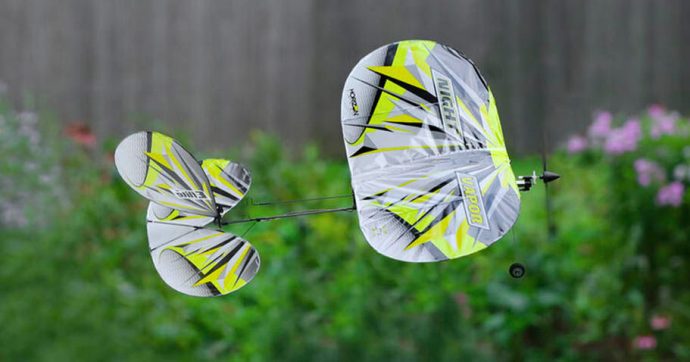
One of its standout features is the factory-installed LED lighting system, which allows for dusk or night flying and gives the plane a unique visual appeal. While it’s not designed for wind or aggressive maneuvers, the Night Vapor excels as a relaxed, confidence-building aircraft that you can fly almost anywhere with enough space.
Buy on Amazon: UMX Night Vapor
E-flite RC Airplane UMX Timber X BNF
The UMX Timber X is a high-performance ultra-micro RC plane designed for pilots who want more power and versatility. It features a brushless motor, large control surfaces, and AS3X stabilization with optional SAFE Select, allowing it to handle everything from slow bush flying to aggressive aerobatics. This makes it a great step up from basic trainers.
Despite its performance, the Timber X remains compact enough to qualify as a micro plane. It has a wingspan of approximately 22.4 inches, a length of about 18.1 inches, and a flying weight close to 4.6 ounces. Oversized wheels allow it to operate from grass, dirt, and rough terrain, while its strong power system provides impressive vertical performance for its size.
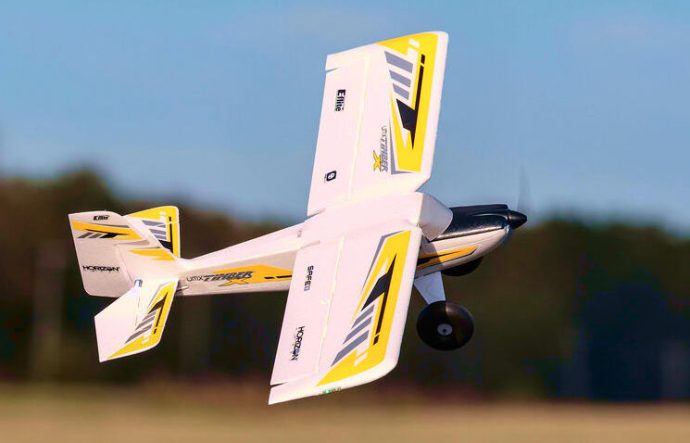
The Timber X is especially popular for its STOL (short takeoff and landing) capability and adaptability. Optional floats allow water takeoffs, and adjustable control throws let pilots tune the aircraft for smooth cruising or 3D-style maneuvers. It’s a durable, capable micro plane that rewards growing pilot skill.
Buy on Amazon: UMX Timber X
E-flite RC Airplane UMX Radian BNF
The UMX Radian is an ultra-micro motor glider designed for smooth, efficient flight rather than speed or aerobatics. It uses AS3X stabilization and optional SAFE Select to deliver calm, predictable handling, making it accessible to beginners while still enjoyable for experienced pilots who prefer relaxed flying.
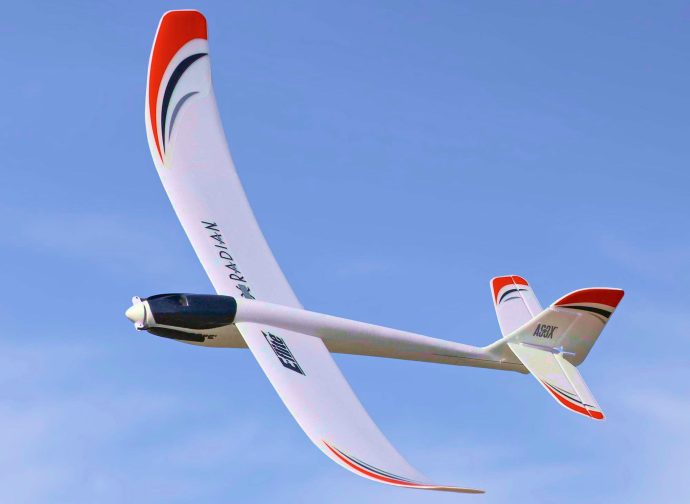
In terms of size, the UMX Radian is larger than most micro planes, which contributes to its excellent glide performance. It features a wingspan of roughly 28.7 inches, a length of about 17.7 inches, and a flying weight of approximately 4.6 ounces. The long wings and lightweight design allow it to stay airborne for extended periods in light conditions.
Once at altitude, the folding propeller reduces drag and allows the Radian to glide efficiently, often achieving 10 to 20 minutes of flight time on a single battery. This makes it ideal for pilots who enjoy thermal hunting, smooth circuits, and long, quiet flights rather than constant throttle input.
Buy on Amazon: UMX Radian
What Are Micro RC Airplanes and Their Main Applications?
Micro RC airplanes are small, lightweight, remotely controlled fixed-wing aircraft designed primarily for recreational flying. Unlike drones or autonomous UAVs, micro RC planes are pilot-controlled at all times and rely on traditional airplane aerodynamics rather than multi-rotor lift. Their compact size allows them to be flown in locations where larger RC aircraft would be impractical or unsafe.
Modern micro RC planes typically feature wingspans between 12 and 30 inches, depending on the model and purpose. They are powered by small electric motors and lightweight batteries, offering flight times that usually range from 5 to 20 minutes, depending on flying style and efficiency. Many current models include stabilization systems that assist with smooth flight and self-leveling, making them accessible to beginners while still enjoyable for experienced pilots.

Micro RC planes are controlled using standard RC transmitters, just like larger RC aircraft. While some models include flight-assist technologies, they are not autonomous and do not perform tasks such as GPS navigation, mapping, or automated flight paths. Their design and purpose are focused on hands-on flying enjoyment rather than aerial data collection or automation.
Micro RC Planes vs Helicopters and Drones
It’s important to distinguish micro RC planes from other remote-controlled aircraft. Traditional RC helicopters use rotating blades to generate lift and require constant control input to remain stable. Micro RC planes, on the other hand, rely on fixed wings, making them more efficient in forward flight and generally easier to fly once airborne.

Micro RC planes should also not be confused with micro RC drones, which dominate much of today’s consumer UAV market. Drones are multi-rotor aircraft designed for hovering, vertical takeoff, and often camera-based applications. RC planes cannot hover, do not take off vertically, and are flown purely for the experience of piloting an airplane rather than capturing aerial footage.
While drones often include GPS, cameras, and autonomous flight modes, micro RC planes focus on manual control, flight skills, and realism. This difference makes RC planes appealing to hobbyists who enjoy the challenge and satisfaction of traditional aircraft flying.
Who Should Use Micro RC Planes and for What Purpose?
Micro RC planes are suitable for a wide range of pilots, from beginners to experienced hobbyists. Entry-level models with stabilization systems are ideal for newcomers, while more advanced designs offer increased performance for pilots who want greater control and challenge.
These planes are designed primarily for recreational use rather than professional applications. Unlike RC drones, micro RC planes are not intended for surveying, mapping, inspection, or aerial photography. Most models do not include cameras and are not designed to carry additional payloads.
Manufacturers typically recommend micro RC planes for users aged 14 and up, although this varies by model. With proper supervision and beginner-friendly designs, younger pilots can also enjoy them safely. Overall, micro RC planes are best suited for anyone who enjoys hands-on flying, learning flight control, and experiencing the fundamentals of fixed-wing aviation.
Buying guide: Important features to consider when you go shopping
First of all, you need to clarify which model is most suitable for you. It depends on your needs, budget, and the experience in RC flying. Micro planes are divided into beginner and professional (most advanced) models based on their features. Today’s mini planes are mainly designed for the beginners, but we can expect in the future more professional micro RC airplanes.
When looking to buy such an aircraft, you should take into consideration the following things:
- Price: In general, small RC planes are much cheaper than the RC drones. Of course, this is the first thing that most people take into account when they go shopping, but do not allow the price limit you if you find a quality, costly model on the web.
- Features: As you can see in the aforementioned models, these flying devices have a lot of great features. Among others, you should consider the flying capabilities and maneuverability.
- Components and specs: Every constructive detail is important, and you must look carefully the specifications related to a certain model. Among others, take a look at the electric motor and rotor, propellers, material, and battery.
- Flight range: It is also important to take into consideration the flight range, i.e., the control distance and flight time.
- Design: The general appearance is something that firstly attracts the customer’s The same goes for the micro planes, but you should consider the quality rather than the external appearance.
- Warranty – Unfortunately, this information does not appear on the Amazon website in most cases, so you shall go on the official website of the particular model and contact the manufacturer via email.
Not sure what model to buy?
Above, you could read about the most popular models of the micro RC airplanes which are offered on the web today, and find out about their purpose, features, benefits, and other useful things related to them.

In addition, it is also of help to see their main advantages and disadvantages before purchasing one.
Pros:
- Easy to control
- Easy to carry wherever you want
- Good maneuverability while flying
- Offer amazing flying capabilities
- Affordable price
Cons:
- Due to the low weight, they are not resistant to the strong winds
- Not capable of carrying a load
- They have a lot fewer features than RC drones
- Cannot be used for the professional tasks
- Do not include the cameras
The small RC planes are a great source of fun, and they have replaced the old airplane toys and surpassed them in any sense. However, you cannot still compare these units with the commercial RC drones because they don’t have such capabilities and features.
Today, micro airplanes are mostly used for fun, however, we can expect more powerful models in the near future that will be capable of recording and equipped with various advanced accessories. Time will show!