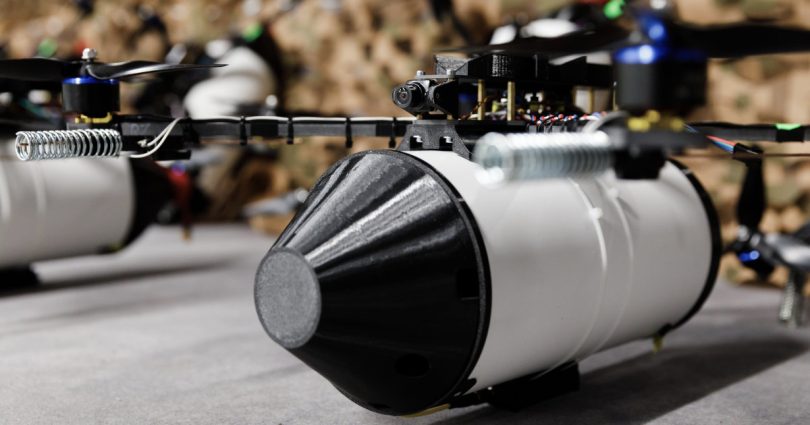

Unmanned Aerial Vehicles (UAVs), commonly called drones, have already changed how modern militaries conduct reconnaissance, surveillance, and even strike missions. But a recent innovation — military drones connected to controllers via fibre-optic cables — is redefining what drone technology can do in high-stakes environments where traditional radio links may fail.
Read our guide on the different types of military drones and their roles in modern warfare: Types of Military Drones
In this article, we’ll explore what fibre-optic military drones are, how they work, why they’re emerging as a game-changer, and what pros and cons they bring to today’s battlefields.
What Are Fibre-Optic Military Drones?
Unlike conventional military UAVs that rely on radio frequency (RF) communication for control and telemetry, fibre-optic drones use a thin physical cable made of optical fibre that stretches between the drone and the operator on the ground.
These drones are often a form of first-person-view (FPV) or loitering munition, meaning they can be piloted directly by a human operator watching real-time video from the drone’s camera — but via a physically connected cable instead of wireless signals.
The fibre-optic link transmits control data and high-resolution video with minimal delay and near-perfect clarity. Because the connection is physical, it’s nearly impossible for enemy electronic warfare systems to jam or block the signal — a key tactical advantage.
How These Drones Work
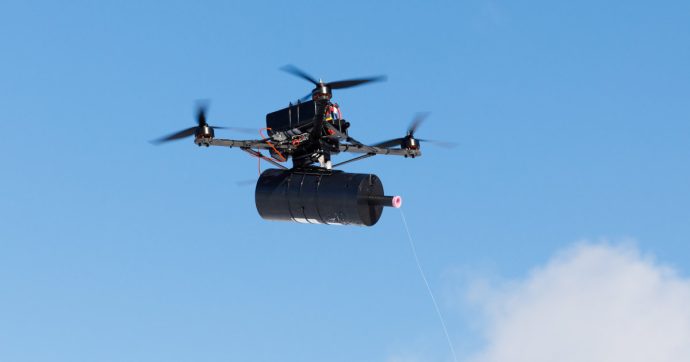
At the heart of the system is the optical fibre tether:
As the drone flies, a spool or reel unreels the fibre-optic cable, keeping the drone physically connected to its ground station.
The cable transmits real-time video and sensor data back to the operator, while simultaneously sending control inputs from the ground.
Typical operational ranges range from about 5 km to 20 km, though experimental models and new developments are stretching this even further.
Because there’s no need to send signals through the air, these drones are effectively immune to RF jamming and electronic countermeasures that can disrupt traditional UAVs.
Real-World Uses and Tactical Advantages
1. Resistance to Electronic Warfare
In conflicts like the war in Ukraine, fibre-optic drones have become valuable because they cannot be jammed or spoofed by electronic warfare systems — a common challenge for conventional drones.
2. High-Quality, Low-Latency Video
Operators receive sharp, real-time feeds directly from the drone’s camera, essential for precise targeting, reconnaissance, and mission assessment.
3. Longer Operational Windows
The fibre link allows drones to linger longer over targets or patrol areas compared to some radio-only models, improving mission endurance.
4. Precision in Complex Environments
Because operators maintain steady data flow, fibre-optic drones can fly closer to obstacles — such as trees or buildings — with more confidence.
Drawbacks and Tactical Trade-Offs
Despite their benefits, fibre-optic drones aren’t perfect:
Physical Cable Limitations: The tether can get caught on terrain or obstacles, which may interrupt the mission.
Heavier and More Complex: Carrying the spool and fibre adds weight and mechanical complexity compared to purely wireless drones.
Range Constraints: While some cutting-edge systems now approach longer distances, the cable limits how far these drones can go compared to some radio or satellite-linked models.
What’s Next?
As military researchers and manufacturers continue to refine fibre-optic UAVs, we can expect:
Longer operational distances
Smarter autopilot and automation features
Hybrid systems blending fibre-optic and wireless links
New tactics designed around jamming-proof drone fleets
No matter what battlefield they operate in, fibre-optic military drones signal a new chapter in unmanned systems — one where connection reliability matters as much as flight performance.